
Introduction:
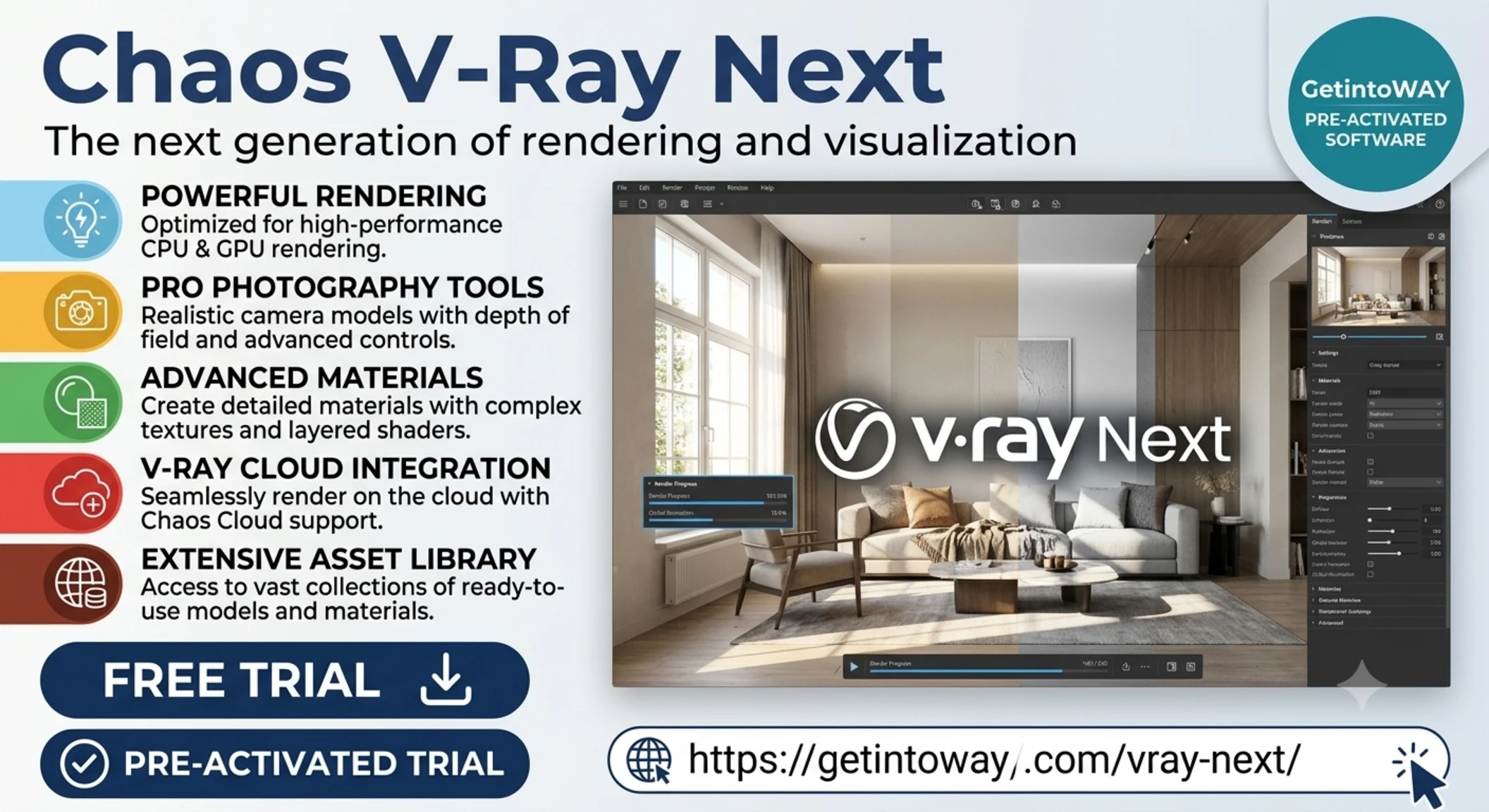
V-Ray Next is a trade ray-tracing software claim created by the firm named Chaos. above all V-Ray is used by architects, designer‘s and 3D artists to install professional quality graphic images integrating network lighting, shading and camera effects. This fine tool for photorealistic display can be used in conjunction with any of the three popular 3D Modeling applications which are 3ds Max, Sketch Up, Rhino, Revit, Maya, and the industry standard for 3D animation application Cinema 4D. The legendary new intelligent rendering engine with GPU acceleration and AI features makes V-Ray Next one of the widely used rendering software.
Key Features:
- High quality photorealistic rendering.
- Robust rendering support for CPU and GPU.
- The Denoiser using AI for rapid rendering.
- Superior lighting and global illumination.
- Photorealistic materials and texture mapping.
- Adaptive Dome Light (added to OP by Mike Johnson) for better HDRI Lighting.
- Interactive fast rendering. It is a hybrid technique that is designed to quickly generate a rough textured appearance of a scene for interaction.
- wide library of fund and samples.
- Easily integrates into all popular 3D applications.
- good working and hence risen performance with a faster flow of work.
How to Download:
- Click on the Download link located on this page.
- Allow the download to complete.
- Extract the ZIP and RAR filing that you downloaded using Win RAR or 7 Zipping.
- When opened, please keep the unzipped folder.
- roll the setup file and run with the fitting.
- start V-Ray Next from your aided 3D application and start creating photorealistic releasing.
Conclusion:
V-Ray Next rendering is a commonly used rendering software used for the rendering of imagery. V-Ray Next is an exclusive software to a pool of big clients such as architects, interior designers, animation studios and 3D artists amongst others. The effects and powerful features such as optimization tools and realistic lighting effects are what make the V-Ray Next a nice choice among its choices.
Data Sheet:
| Feature | Details |
|---|---|
| Software | V-Ray Next |
| Developer | Chaos |
| Category | 3D Rendering Software |
| Operating System | Windows 10/11 (64-bit) |
| System Requirements | 8 GB RAM, Multi-Core Processor, OpenGL-Compatible GPU, 2 GB Free Disk Space |